How to find content opportunities in Google Search Console without chasing rankings
Find practical content opportunities in Google Search Console by turning query and page patterns into bounded editorial hypotheses.

Search Console can make a quiet website look busier than it is. Thousands of impressions, hundreds of queries, average positions with decimals, and little arrows pointing up or down create the feeling that an answer is hiding somewhere in the dashboard.
The answer is rarely “write more articles about the query with the largest number.” The useful output is a hypothesis: a specific page may serve a specific search need better if you make a bounded change.
You can find those hypotheses with three views. You do not need a giant export or a ranking tracker to begin.
View 1: queries that reveal a different reader job
Open the Search results Performance report, choose a useful comparison period, and inspect queries connected to a page. Google’s guide to common Search Console tasks explains how to move between query and page views and how to compare changes.
Do not scan only for the most impressions. Look for query families that imply a job your page does not currently handle.
Imagine an article called “How to build a founder content system.” It appears for these groups:
founder content calendar
content workflow for one person
how to review AI content
founder content examples
The first two may fit the existing job. The third could expose a missing section. The fourth might deserve a separate example library rather than another paragraph in the workflow article.
Write the observation without interpreting it yet:
The page appears for review-related queries, but the current article only mentions review in one sentence.
That is evidence. “Google wants a full review framework on this page” is an explanation, and you have not earned it.
View 2: pages with visibility but weak search-result appeal
Low click-through rate is useful when it is treated as a prompt to inspect, not a verdict. Search Console’s guidance notes that low CTR can indicate that a result does not seem to answer the query and suggests checking titles, descriptions, and alignment. The word “can” matters.
CTR varies by query, position, device, intent, and the shape of the results page. A definition query with an immediate answer may behave differently from a comparison query. Brand queries behave differently from unfamiliar problems.
Use this sequence:
Select a page with meaningful impressions.
Inspect the specific queries producing those impressions.
Search the important query manually if appropriate and note the result types and dominant promise.
Compare that promise with your title and page opening.
Decide whether the mismatch is in presentation, substance, or intent.
There are three common outcomes:
Presentation mismatch: the page is useful, but the title is vague or generic.
Substance mismatch: the title promises a decision the article does not resolve.
Intent mismatch: the page is showing for a query it should not try to win.
Only the first two are editing opportunities. The third may simply be noise.
View 3: movement that deserves an explanation
Compare a recent period with the previous period or a comparable period last year when seasonality matters. Sort for meaningful changes in clicks and impressions. Google recommends paying attention to trends in clicks and impressions rather than over-focusing on average position.
Put movement into four buckets:
Impressions up, clicks up
The page may be reaching more demand or appearing for more relevant queries. Inspect which query groups changed before celebrating or expanding the article.
Impressions up, clicks flat
The page may be gaining visibility without gaining appeal. Check whether new queries are loosely related, whether the result promise is weak, or whether search features answer the need without a click.
Impressions down, clicks down
Demand, competition, site changes, indexing, or page quality could all contribute. Do not rewrite immediately. Compare affected queries, check the page, and look for changes beyond the content itself.
Impressions flat, clicks up
The page may be matching its visible audience better. A title change, a shift in query mix, or an external factor could be involved. Record the timing and resist claiming causation from coincidence.
Turn patterns into opportunity cards
For each promising pattern, create a small card:
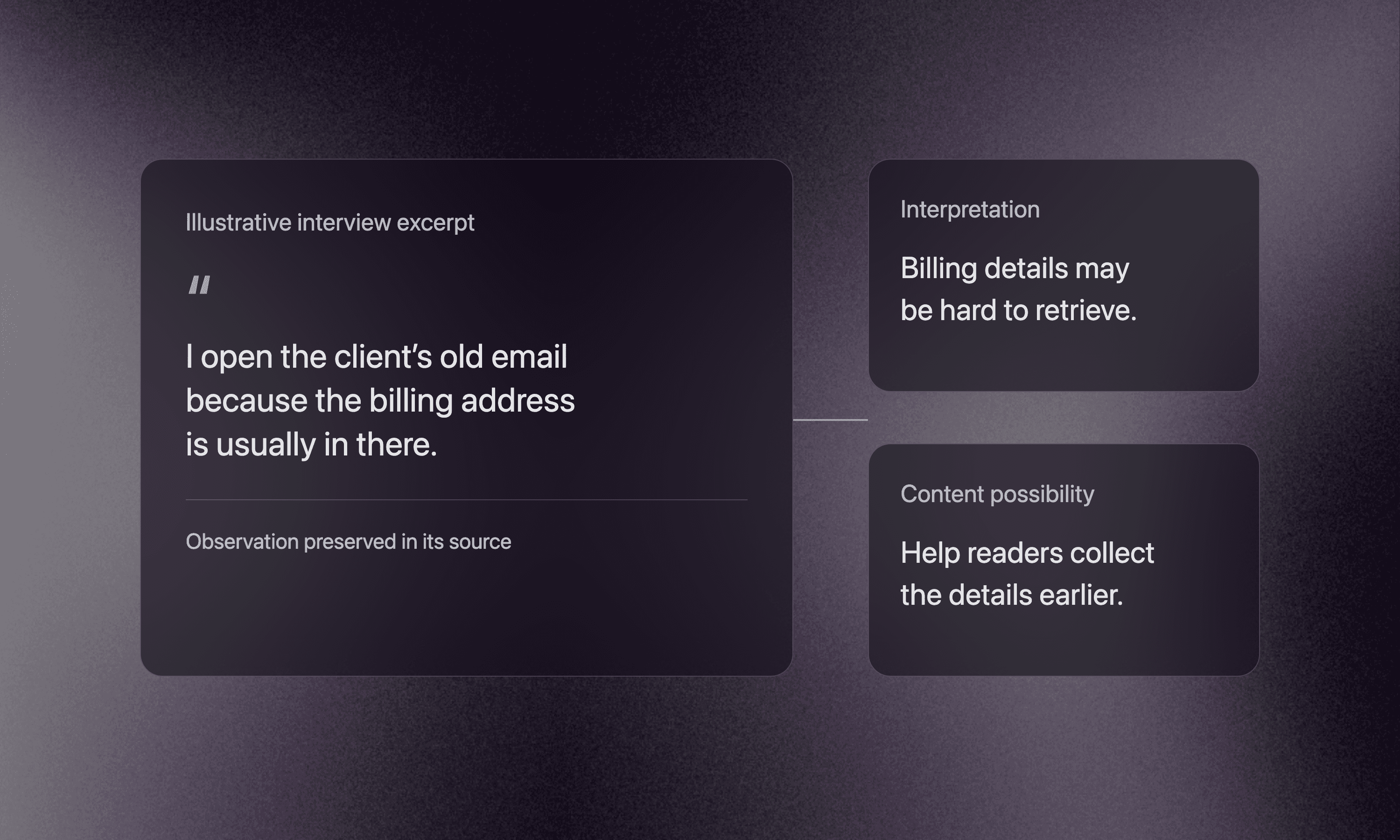
Observation
What Search Console actually shows.
Reader job
What the query group suggests someone is trying to decide, do, or understand.
Page gap
What the current page fails to provide.
Proposed change
One bounded edit or new asset.
Expected signal
What could move if the hypothesis is sound.
Review date
When you will inspect the result.
Here is a complete example:
Observation: An article about content briefs receives growing impressions for “content brief approval checklist,” but few clicks and contains no approval criteria.
Reader job: Decide whether a brief is ready to hand to a writer.
Page gap: The article explains fields but not acceptance standards.
Proposed change: Add a five-question approval test and revise the title to include readiness.
Expected signal: Better clicks and engagement from approval-related queries.
Review date: Six weeks after publication.
The card makes the reasoning inspectable. If results do not improve, you can revisit the hypothesis instead of vaguely deciding that SEO failed.
Use advanced filters carefully
Search Console’s advanced filtering documentation supports query and URL filters, comparisons, and regular expressions. These are useful for grouping related queries, separating branded from non-branded language, or isolating a directory.
Filters also change what you can see. Query data can be truncated, anonymized queries are omitted, and totals may differ between views. Keep a note of the filter, date range, search type, and device when you record an observation. Otherwise, the same chart may tell a different story when someone recreates it.
A simple query-family expression can help group variations, but do not make the grouping more sophisticated than the decision. If the question is “Are readers finding us through audit-related language?”, a modest set of audit terms is enough to begin.
Separate three kinds of opportunity
Not every opportunity should become a new post.
Improve an existing page
Choose this when the query job belongs naturally inside the page and the current treatment is weak.
Create a distinct page
Choose this when the reader job, intent, or required depth differs enough to deserve its own destination.
Improve the route
Sometimes the content exists, but the path does not. Add a contextual internal link, clarify navigation, or connect a high-visibility explainer to a decision page.
This third option is easy to miss because content planning tends to equate opportunity with production. Better routing can create more value than another article.
Limit the review to three actions
A founder can spend an afternoon discovering 30 plausible improvements and finish none. End each review by choosing three:
One existing-page improvement
One routing or internal-link improvement
One new content experiment, if the evidence supports it
Rank them by reader value, evidence strength, effort, and strategic fit. Save the rest as observations, not commitments.
Measure the change without inventing certainty
Record the change date. Keep the comparison window long enough for the site’s traffic level. Compare the same query family and page. Note any other meaningful events, such as a product launch, a redesign, or unusual demand.
Then use careful language:
“Clicks increased after the title and opening changed” is an observation.
“The title change caused the increase” is a causal claim.
“The improved match may have contributed” is a reasonable interpretation when other evidence points the same way.
Search Console is most useful when it sharpens editorial questions. Treat it as an instrument panel, not an oracle. The goal of the review is a small set of explicit bets that help real readers, can be checked later, and teach the team something whether they win or lose.