Founder-led content vs hiring a marketer: how to choose
Compare founder ownership and specialist support across insight, production, distribution, and management capacity.
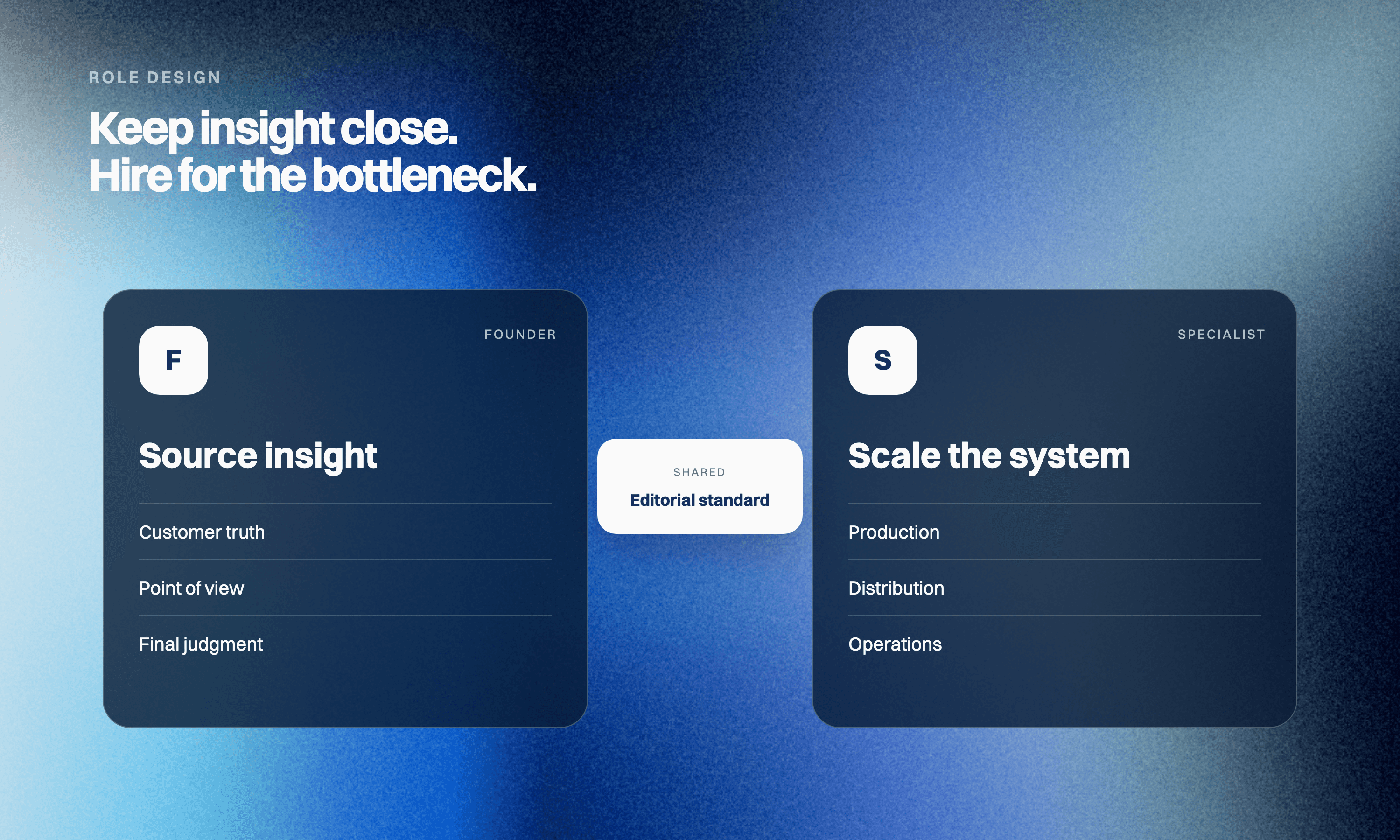
Founder-led content vs hiring a marketer becomes useful when it helps a real person make a better marketing decision. For early-stage founders deciding whether to keep content in-house or make their first marketing hire, the challenge is rarely a shortage of tools. The decision is framed as time versus money, while the real constraint may be insight, production skill, or management attention.
Keep the founder close to ideas and proof; hire when production or distribution has become the repeatable bottleneck.
What this problem looks like in practice
Founders often feel the problem as inconsistency: a strong week followed by silence, a full idea list with nothing ready to publish, or several channels that never quite support one another. The visible symptom is missed cadence. The deeper issue is that the business has not defined what the content is meant to do and how it will move from an observation to a finished asset.
A practical system starts smaller. It chooses one reader, one useful job, and one repeatable path. That makes quality easier to see and makes improvement possible after the work ships.
The core principle
Keep the founder close to ideas and proof; hire when production or distribution has become the repeatable bottleneck.
This is also consistent with LinkedIn's founder marketing guide. The useful lesson is not to copy another company's cadence or channel mix. It is to design around the audience you actually serve, the expertise you can support, and the capacity you can maintain.
Hiring someone to discover the company's point of view from scratch. That turns a production problem into a positioning project.
A workable process
1. Diagnose the real bottleneck
Start with diagnose the real bottleneck. Be specific about the reader situation or business constraint this choice is meant to address. A narrow first decision gives the rest of the workflow a stable reference point.
2. Separate insight from production
Next, separate insight from production. Capture the raw material before polishing it, then group what you find by the decision it helps the reader make. This keeps research connected to a practical job.
3. Document the current process
For the third stage, document the current process. Choose the smallest version that can be finished well with the people and time available. A manageable format leaves room for examples, review, and distribution.
4. Test specialist support on one format
Then test specialist support on one format. Write the rule down so the choice can be repeated without relying on memory. The goal is not rigid standardization; it is giving the next run a useful starting point.
5. Hire for the constraint that persists
Finally, hire for the constraint that persists. Decide who checks the result, what evidence matters, and where the finished asset will be recorded. Closing the loop turns production into a system that can learn.
A concrete example
A founder with strong customer notes but no publishing rhythm may need an editor or content operator, not a head of marketing. The founder keeps the source insight; the specialist turns it into a reliable system.
Notice what makes the example practical: the audience situation is visible, the content job is narrow, and the output has somewhere to go. The team does not need more random ideas. It needs a reliable way to turn existing knowledge into something the reader can use.
Where AI can help
AI can reduce drafting and coordination work, which may delay a full-time hire. It does not remove the need for editorial judgment or channel ownership.
The safest role for AI is inside a workflow with clear inputs and a visible review standard. It can speed up sorting, outlining, adaptation, and cleanup. It should not be asked to invent customer truth, performance claims, or a point of view the business has not earned.
How to make the system sustainable
A sustainable approach to founder-led content vs hiring a marketer needs a deliberately small starting point. Begin with diagnose the real bottleneck, then protect enough time to finish the asset and observe what happens. Do not add another channel, format, or approval layer until the current path works without a rescue effort. Complexity should be earned by a real bottleneck, not added because a larger system looks more professional.
Write the current version down in plain language: the input, the owner, the output, and the review condition. This short operating note makes hidden assumptions visible and gives the next run something concrete to improve instead of forcing the team to reconstruct the process from memory.
Keep one example beside that note. An example shows the level of specificity the process expects and makes future review much faster. It can be a strong source observation, a useful outline, a clean handoff, or a finished asset that demonstrates the standard. Replace the example when the process improves. This avoids turning the written workflow into a rigid policy while still giving collaborators and tools a concrete reference for what good looks like.
The weekly review can stay simple. Ask what took longer than expected, which decision required the founder, where the draft became generic, and whether the final asset reached the intended reader. Those answers show whether the next improvement belongs in research, writing, design, distribution, or review. They also keep a tooling problem from disguising a strategy problem.
For early-stage founders deciding whether to keep content in-house or make their first marketing hire, capacity is part of quality. A system that works only during a launch sprint is not yet an operating habit. Keep the minimum cadence low enough that examples remain real, claims remain supportable, and someone can respond after publication. When the archive becomes coherent and the production path stops breaking, increasing the pace becomes a reasonable experiment rather than a hopeful commitment.
Signals that the workflow is improving
Look for operational evidence before chasing vanity metrics:
Strong ideas reach a finished state with fewer emergency edits.
The same customer language appears coherently across several formats.
Review comments become more specific because the quality standard is visible.
Distribution happens as part of the asset plan rather than as an afterthought.
The next topic comes from reader response, customer questions, or product learning.
These signals do not guarantee growth, but they show that the business is building a system capable of learning. That is a stronger foundation than adding volume while the same production and positioning problems repeat.
Pre-publish checklist
The founder can supply useful raw material
The format has shown strategic value
The process is documented
Feedback can be given clearly
The hire has a measurable job
If several items are unclear, reduce the scope before increasing the cadence. A narrower piece with a specific reader job is usually more valuable than a broader piece that sounds complete but leaves the reader with no next move.
What to do next
Start with the first step and apply it to one real asset this week. Keep a short note on what slowed the work down, what needed the most editing, and what the reader responded to. That note is the beginning of a better system.
Founder-led content vs hiring a marketer does not need to become a complicated marketing operation. It needs a clear purpose, a manageable rhythm, and a review step strong enough to protect the brand. Once those are stable, tools and automation can make the work faster without making the thinking thinner.