Repurposing Blog Posts into Carousels: A Figma Workflow
Learn how repurposing blog posts into carousels maximizes your content ROI. Follow our Figma workflow to turn long-form SEO articles into high-reach assets.

Repurposing blog posts into carousels is the process of extracting core insights from long-form articles and transforming them into swipeable, visual social media assets. This workflow allows SaaS companies to maximize content ROI by distributing SEO-driven ideas across platforms like LinkedIn and Instagram using Figma.
Why should you start repurposing blog posts into carousels?
Repurposing blog posts into carousels is a strategic method to extend the lifecycle of your long-form content. Most SEO-driven blog posts see a traffic spike at launch followed by a steady decline in visibility. By converting these posts into native visual assets, you reach users who prefer consuming high-density information directly within their social feeds without clicking an external link.
Native content performs better because algorithms prioritize keeping users on the platform. LinkedIn carousels generate approximately 1.92% engagement, which is nearly double the engagement rate of standard image posts at 1.1% (Socialinsider, 2024). This difference means your existing ideas get twice the impact when you change the format from a text-heavy URL to a visual slide deck. We see this as a distribution arbitrage: the intellectual work is already done, and the design phase simply extracts that value for a new audience.
SaaS founders often spend thousands on high-quality articles that remain buried in archives. A visual summarization of these articles ensures that your best arguments reach decision-makers who scroll through social media during their workday. According to the Content Marketing Institute, 60% of marketers find that repurposing existing content is more effective for lead generation than creating new assets from scratch (Content Marketing Institute, 2023). By adopting a systematic workflow, you turn your blog into a content engine that fuels your social media presence daily. This approach ensures your brand remains top-of-mind without requiring your team to come up with new topics every week.
What is a visual summarization strategy?
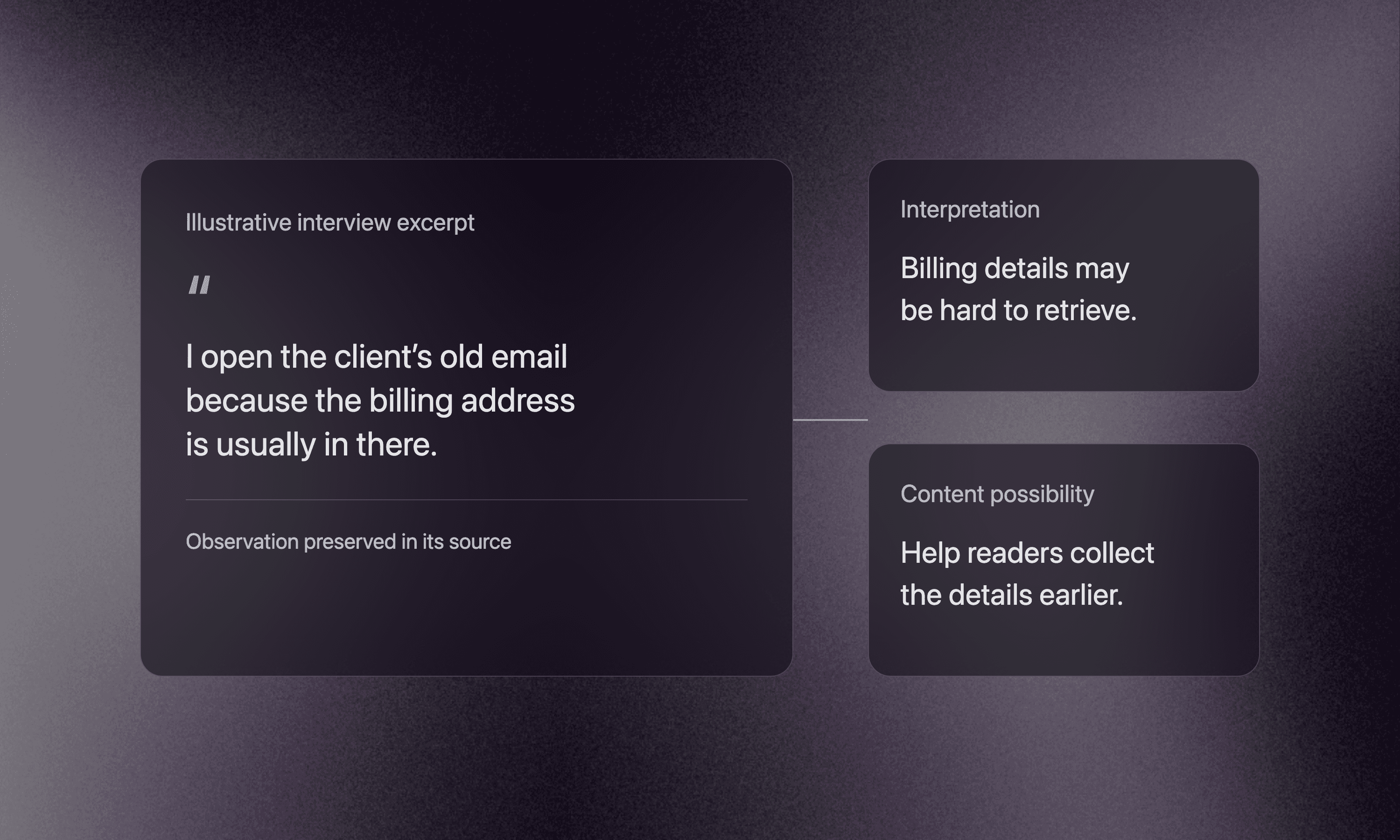
Visual summarization is the tactical condensation of a 1,500-word article into 10 key visual frames. It requires identifying the most provocative or educational points and stripping away the fluff to leave only the core value. This strategy ensures that the user receives the maximum benefit in the shortest possible time, which is essential for maintaining attention in a crowded feed.
The goal is not to copy the blog post word-for-word. Instead, you must curate the information. Start by selecting one primary takeaway per slide. Use a strong headline to anchor the slide and a short explanatory sentence or a list of bullet points for context. This structure mirrors how users scan digital content, focusing on headers before deciding to read the details. Visual hierarchy is the tool we use to guide the reader's eye toward the most important data or advice.
Effective visual summarization relies on structural clarity and high-impact data points. Research shows that posts containing data visualizations or specific statistics see a 34% increase in sharing compared to purely qualitative posts (Demand Metric, 2023). When we summarize a blog post, we look for these specific numbers or "aha" moments that define the article's value proposition. A citability passage within a carousel is a slide that stands alone as a complete thought, often formatted as a bold statement or a comparative table. This makes the content more likely to be saved by the user for later reference. When your blog to social media process focuses on these high-value snapshots, you increase the likelihood of your content going viral within your specific niche.
How do you build a blog to social media workflow?
A blog to social media workflow is a repeatable sequence of steps that moves an idea from a CMS to a visual design tool. The first step is the audit, where you select high-performing articles that have already proven their value through search traffic or community feedback. Once selected, the article is broken down into a storyboard that dictates the flow of the carousel slides.
We recommend a standard 10-slide structure for most carousels. Slide one is the hook, slide two is the problem or "the status quo," slides three through eight are the solution steps or key points, slide nine is the summary, and slide ten is the call to action. This narrative arc keeps the user engaged until the final frame. By mapping the blog's subheadings to these slides, you ensure the carousel remains faithful to the original piece while being optimized for mobile consumption.
The technical transition from text to visual requires a dedicated scripting phase. In our experience, trying to design and write simultaneously leads to cluttered layouts and inconsistent messaging. Write your carousel script in a plain text document first, limiting each slide to under 40 words. This constraint forces you to be precise. Once the script is finalized, it can be pasted into a Figma template designed for rapid production. Using a 1080x1350 pixel frame size is the best practice for vertical carousels as it occupies 20% more screen real estate than a square post (Socialinsider, 2024). This extra space allows for larger typography and better readability, which are the primary drivers of completion rates. A disciplined workflow reduces the time spent on design by separating the creative thinking from the execution phase.
How does Figma Auto Layout simplify content production?
Auto Layout in Figma is a feature that lets components resize dynamically based on their content. It is the most powerful tool for repurposing blog posts into carousels because it removes the need to manually adjust spacing when text lengths vary. If a slide from one blog post has two lines of text and the next has five, Auto Layout adjusts the margins and container size instantly.
To use this effectively, create a master component for your slides with pre-defined padding and alignment. Set your text layers to "Fill Container" so they wrap automatically as you paste in content from your blog. This ensures every slide looks professional and cohesive regardless of who is performing the task. Teams often use a library of pre-built assets to maintain consistency, such as the systems we build at usevisuals to support fast-moving marketing teams. These systems allow you to swap headers, icons, and background colors across an entire 10-slide deck with a few clicks.
The speed gained from Auto Layout allows for higher volume without sacrificing quality. In a typical manual design workflow, shifting a single text box might require moving every other element on the screen. With Figma's layout engine, those relationships are governed by rules you set once. Statistics from design operations reports indicate that using design systems and automated layout tools can increase production speed by up to 200% for marketing teams (Hubspot, 2023). This efficiency is critical for SaaS companies that need to maintain a high frequency of posts to stay relevant in the algorithm. By building a robust Figma system, you ensure that your design quality remains premium even when you are shipping content daily. Consistency in spacing, alignment, and typography builds brand credibility and signals to your audience that you are an established player in your industry.
How can you maximize content ROI with this system?
You maximize content ROI by reducing the cost of distribution while increasing the total reach of a single intellectual asset. When you view a blog post as a raw material rather than a finished product, you can generate multiple pieces of content from one research effort. This reduces the "cost per post" significantly over time.
Consider the math of content production. If an original blog post costs $500 to produce and generates 500 visitors, your cost per visitor is $1.00. If you spend 30 minutes repurposing that post into a carousel that reaches 5,000 people on LinkedIn, your total reach for that $500 investment grows by 10x. This efficiency is why SaaS content distribution strategies are shifting toward a modular approach. You are not just creating a carousel; you are creating a visual summary that can be used in newsletters, sales decks, and internal training materials.
The ROI also comes from the compound effect of visual branding. Consistent visual content builds trust faster than text alone. Studies on consumer behavior show that users form an opinion about a brand's credibility within 0.05 seconds of seeing its visual assets (Google Research, 2012). If your carousels look premium and cohesive, that trust carries over to your software product. A structured repurposing strategy ensures that every social touchpoint reinforces your brand identity. By using Figma to maintain this visual standard, you ensure that the effort spent on the original blog post continues to pay dividends for months. High-performing carousels can be re-shared every 90 days, reaching new segments of your growing audience without requiring any additional writing or design work. This is how lean marketing teams out-compete larger agencies with much bigger budgets.
What are the core steps for a content repurposing strategy?
A content repurposing strategy is a systematic plan for transforming one piece of content into various formats to reach a wider audience. For SaaS companies, this usually starts with a deep-dive technical article or a customer success story. The strategy must define which formats are high-priority based on where the target audience spends their time.
Follow this five-step sequence for every blog post you publish:
Identify the "Gold Nuggets": Highlight 5-7 actionable takeaways from the post.
Draft the Script: Convert those takeaways into slide-friendly headlines and bullet points.
Apply the Template: Paste the script into your Figma carousel component library.
Review for Visual Hierarchy: Ensure the most important word or number on each slide is the largest.
Schedule for Distribution: Post the carousel 24-48 hours after the blog goes live to create a second peak in engagement.
Effective repurposing is about consistency rather than perfection. You do not need to repurpose every single blog post. Instead, focus on the top 20% of posts that drive 80% of your results. According to research by Orbit Media, bloggers who spend more time on distribution and repurposing report 2.5x better results than those who only focus on publishing new content (Orbit Media, 2023). This data underscores the importance of having a documented content repurposing strategy. When your team follows a set workflow, the friction of "what to post next" disappears. You are simply executing a process that has already been validated by your SEO performance. This shift from creative guesswork to process-driven distribution is what allows startups to scale their marketing without hiring a massive team of designers and writers.
Which common mistakes ruin carousel conversion?
One common mistake is including too much text on a single slide. When a user sees a wall of text on social media, they keep scrolling. A carousel is a visual medium, not a replacement for the blog post itself. Your goal is to spark curiosity and provide immediate value, not to provide an exhaustive technical manual in 10 frames.
Another frequent error is poor contrast and illegible typography. If your brand colors are light gray and white, your text will be impossible to read on a mobile device in sunlight. Accessibility is a key component of design that directly impacts your conversion rates. Use high-contrast color pairings and ensure your font size is at least 18px for body text and 40px for headlines. Failure to prioritize readability signals a lack of professionalism and can damage your brand credibility among sophisticated SaaS operators.
Element | Common Mistake | The Professional Fix |
|---|---|---|
Text Volume | Over 100 words per slide | Max 40 words per slide |
Typography | Small, thin fonts | Large, bold sans-serifs |
CTA | Vague "check us out" | Specific "Download the checklist" |
Structure | Random order of ideas | Linear, logical narrative arc |
Neglecting the call to action is the third major mistake. Every carousel must have a clear objective. Are you trying to drive traffic to the full blog post, get newsletter signups, or encourage comments? A carousel without a clear CTA is a wasted marketing opportunity. In our experience, carousels that end with a specific, singular request see significantly higher conversion rates than those with multiple competing links. Make it easy for the reader to take the next step by telling them exactly what to do. If they have swiped through 10 slides, they are already engaged. Don't lose them at the finish line by being vague about the next step in your funnel.
How do you optimize carousels for SaaS content distribution?
SaaS content distribution requires a focus on authority and problem-solving. Your audience consists of busy founders and operators who value their time. To optimize for this group, your carousels should focus on solving a specific pain point mentioned in your blog post. Use technical terminology correctly and show real examples of your product or workflow in action.
Leverage the "Slide 1" hook to call out your specific persona. Instead of a title like "How to grow on LinkedIn," try "How SaaS Founders grow on LinkedIn." This specificity improves the quality of your leads by filtering out irrelevant users. When you optimize for a specific niche, your content becomes more shareable within that community. According to a study by Demand Gen Report, 67% of B2B buyers rely more on content to research and make purchasing decisions than they did a year ago (Demand Gen Report, 2023). This means your carousels aren't just social posts; they are sales enablement tools that live in the feeds of your future customers.
Finally, ensure your Figma workflow includes a step for platform-specific optimization. While the 1080x1350 size works for most, you might want to adjust the CTA slide for different platforms. LinkedIn users might respond better to a PDF download, while Instagram users might prefer a link in the bio. By maintaining a single source of truth in Figma, you can create these variations in seconds. This level of detail in your SaaS content distribution plan separates the premium brands from the amateur ones. High-quality visual summaries of your best blog posts position you as an expert and make your marketing feel like a natural extension of your product's user experience. When design and content are in sync, your growth becomes predictable and scalable.
References
Social Media Industry Benchmark Report. Socialinsider, 2024.
B2B Content Marketing Insights for 2023. Content Marketing Institute, 2023.
The State of Visual Content Marketing. Demand Metric, 2023.
The Power of Visual Communication in Marketing. Hubspot, 2023.
Users Form Opinions in 50 Milliseconds. Google Research, 2012.
Annual Blogger Survey Results. Orbit Media, 2023.
B2B Buyer Behavior Survey. Demand Gen Report, 2023.