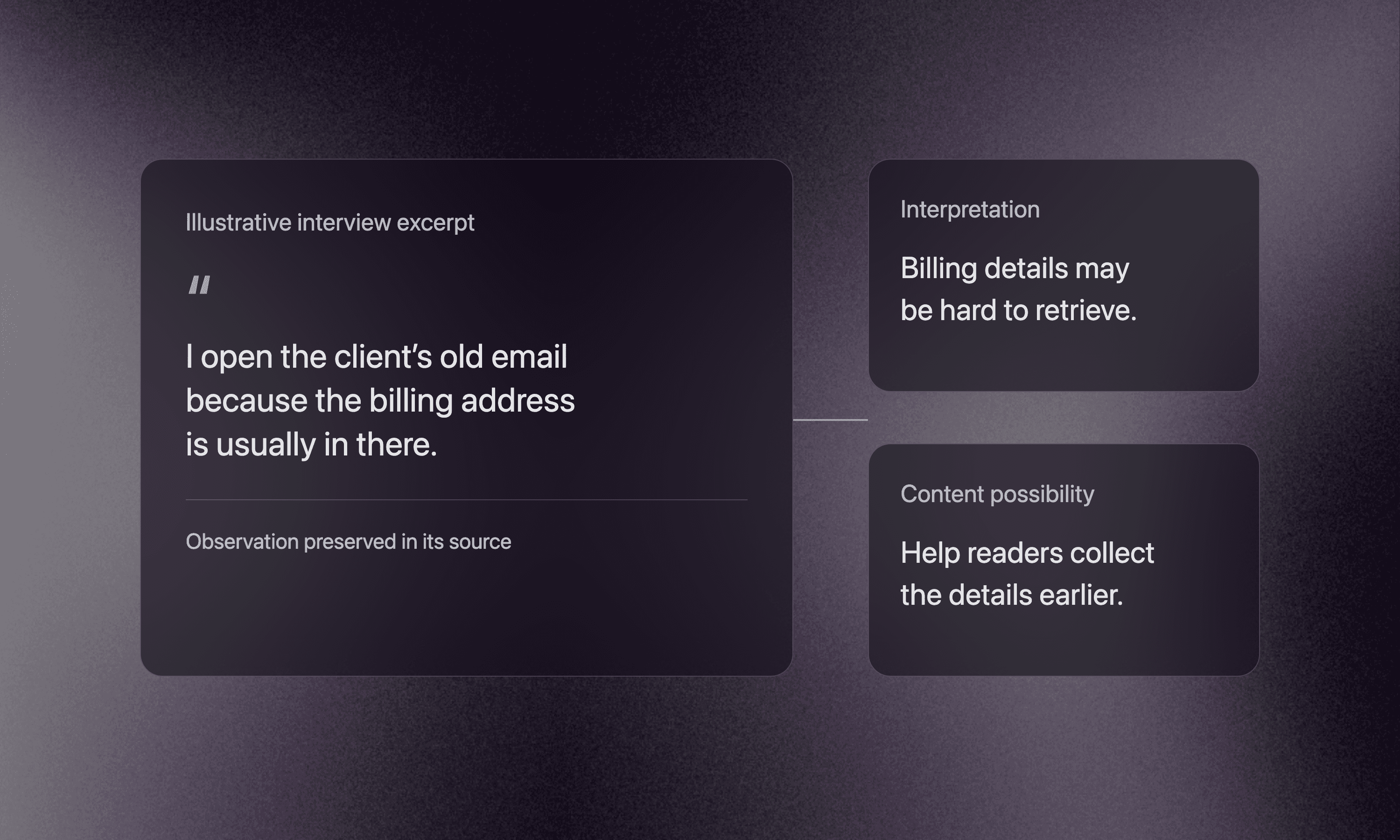
AI content brief vs prompt for a recurring marketing workflow
Decide what belongs in reusable context, an article brief, and an AI prompt. Includes an annotated example and a rule for resolving conflicting facts.
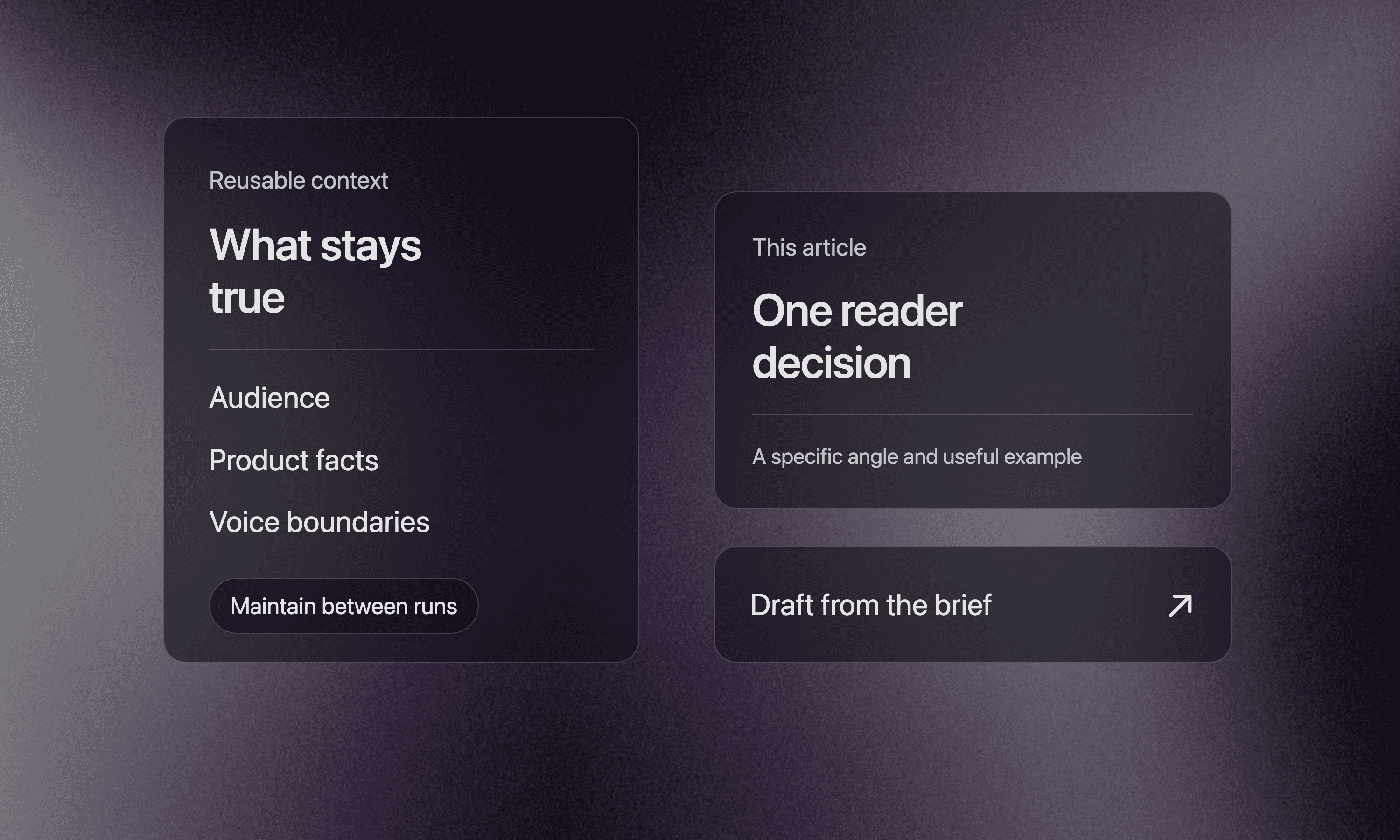
An AI content brief and a prompt do different jobs. The brief records the editorial decisions behind a piece. The prompt asks the model to perform a task using those decisions. Reusable business context supplies the facts that should remain consistent between pieces.
That distinction matters when a founder asks AI to write every week. A good instruction cannot settle an unresolved audience question. A detailed company document cannot choose the angle of Tuesday’s article. Combining everything into one long message may work once, but it makes the next run harder to inspect and change.
Choose the smallest arrangement that keeps those decisions visible. For a recurring workflow, that usually means a maintained context document, a brief for each piece, and a short execution instruction.
Compare the jobs before comparing the formats
A brief can live in a document, a project note, or the same message as a prompt. File separation is a convenience. The important boundary is what each part controls.
Material | Question it answers | Typical lifespan |
|---|---|---|
Business context | What is true about the business and its audience? | Until the underlying facts change |
Content brief | What should this particular piece help a reader do? | One piece or a closely related commission |
Task prompt | What should the AI do with the supplied material now? | One stage of the work |
This is a recommended editorial arrangement, not a required AI interface. It borrows a narrow principle from Anthropic’s explanation of context engineering, which treats the information available to a model as something to curate and maintain, beyond the wording of a single instruction.
For marketing work, the practical implication is selective inclusion. Supply the facts, evidence, and decisions relevant to the assignment. Do not assume that adding every old campaign note will improve the result.
Follow one article through the three documents
Consider a fictional invoicing product for independent consultants. The founder wants an article that helps consultants request missing purchase-order details before an invoice is sent. The product and all sample wording below are illustrative.
The reusable context holds product truth
The context might establish that the product creates invoices and tracks payment status. It does not negotiate with a consultant’s client or guarantee payment. Its audience includes consultants who invoice businesses with formal purchasing requirements.
Those facts belong in reusable context because several articles need them. They constrain the claims the writer can make without forcing every article to mention the product.
The context should also distinguish a released feature from a planned one. A note about a future purchase-order reminder is not permission to describe that reminder as available. Put the status beside the feature so the writer does not have to infer it from the date of an old meeting.
A voice note can be equally concrete. Prefer a direct request a consultant could send to a client. Avoid portraying routine administrative work as a dramatic transformation. That guidance travels well across topics because it describes how the business communicates.
The brief makes this article worth writing
The brief narrows the reader to a consultant whose work has been approved but whose invoice may be delayed by missing purchasing details.
Its reader job is to prepare a short request that gets the required information without implying that payment is overdue. Its argument is that checking the client’s requirements before issuing an invoice can prevent avoidable rework. That is a proposed practical approach, not a promise of faster payment.
The brief should specify the example it needs. In this case, the article can show a sample email that asks for the billing entity, reference details, and the person who can confirm the client’s process. It should explain which parts the consultant must adapt.
It should also mark the boundary. This is not a guide to tax compliance, debt collection, or every possible invoicing rule. A reader seeking those answers needs different evidence and, potentially, professional advice. The article remains useful because it solves a smaller communication problem thoroughly.
Notice how little of that belongs in the permanent company description. Next week’s article may help a consultant choose a payment-status update. The product truth can stay the same while the reader situation, example, and argument change.
The prompt starts a particular stage
The instruction can now be short and concrete.
Draft the article from the approved brief and current business context. Open with the consultant’s immediate decision. Include the sample request and explain how to adapt it. Treat missing facts as unresolved. Return the article body in Markdown, without metadata or a separate title block.
A different instruction can request an outline, critique, or source check using the same brief. This makes revision easier to diagnose. If the argument is wrong, revisit the brief. If a feature claim is wrong, inspect the context and the draft. If the output contains unwanted metadata, clarify the task instruction.
Do not keep adding instructions to compensate for a brief that still says only “write about invoicing.” That leaves the model to choose the actual editorial assignment.
Resolve contradictory material before drafting
Suppose an old launch note says the product has a free tier, while the current product sheet lists only paid plans. Sending both documents and asking for accuracy leaves an unresolved publishing decision inside the writing task.
Name the authoritative source for the disputed fact. Archive or clearly label the older note. If nobody can establish the current offer, omit the claim until the owner confirms it.
Use the same approach for audience conflicts. A sales note may discuss agencies, while the approved positioning focuses on independent consultants. Both can be true observations without making both audiences appropriate for this article. The brief needs to choose whom it serves.
AI can help locate contradictions by returning the competing passages and their sources. The useful output is a short decision list. A fluent compromise, such as inventing a broader audience or an intermediate price, would hide the problem.
A small task does not need three attachments
If you are rewriting a short event reminder and all relevant facts fit in the request, a single message may be enough. State the audience, date, action, and wording constraint together. Separate documents would add maintenance without much benefit.
The distinction becomes useful when facts recur, several people contribute, or mistakes keep returning between runs. Repeatedly correcting the same offer detail is a reason to improve shared context. Repeatedly rejecting generic angles is a reason to improve briefs.
There is no need to rebuild the whole workflow at once. Start with the fact that causes the most rework, give it a maintained home, and reference it from the next assignment.
Test the handoff with a reader decision
Before commissioning the draft, ask a colleague to read only the brief. They should be able to name the reader’s situation, the decision the article enables, the example that carries the explanation, and the claims that remain off limits.
Then read the task instruction without the brief. It should describe an action clearly but should not contain hidden strategic choices that belong in the assignment.
If those two checks work, save the draft alongside the brief that produced it. The next revision can then change a visible decision instead of starting another round of guesswork about which wording made the AI cooperate.