Turn customer interview notes into content without inventing quotes
Keep customer language traceable when AI helps turn interviews into content. Separate quotations, interpretations, and editorial claims with a worked example.
“I check the invoice before I send it” becomes “Your product gives me complete financial confidence.” The second sentence sounds like better marketing. It is also a different claim, and putting quotation marks around it would misrepresent the speaker.
Using customer interview notes for content requires a visible boundary between what someone said, what you think it means, and what you decide to publish. AI can help organize the material, but a convincing summary is not evidence that the interview supports its wording.
Keep a route back to the original observation for every customer-derived claim. That route is more useful than a folder full of polished testimonials whose origins nobody can recover.
Open an evidence packet before opening a draft
The following packet is entirely fictional and exists to demonstrate the method. It is not customer research or a testimonial.
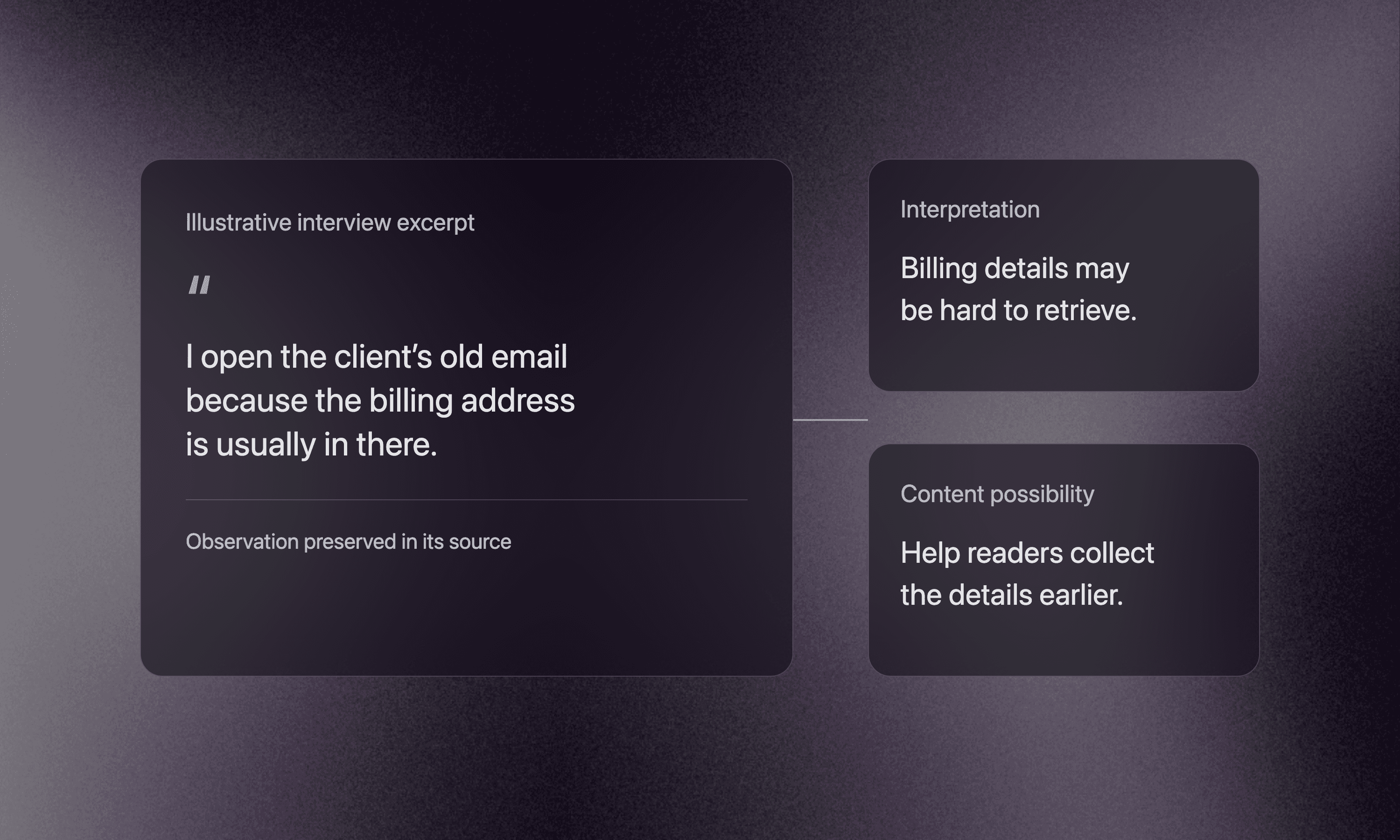
A consultant in an imagined interview says, “I open the client’s old email because the billing address is usually in there.” The interviewer had asked what happens immediately before an invoice is prepared.
The original observation is narrow. This participant retrieves billing details from an earlier message. It does not establish that all consultants do this, that the process causes late payment, or that a particular product solves the problem.
An internal interpretation might be that the participant lacks an easy place to find billing details at the moment of invoicing. A potential content angle could explain how to collect and confirm those details before preparing an invoice.
Those are useful editorial moves when their status remains visible. They become misleading when the interpretation is rewritten as the participant’s words or the angle is promoted into a market-wide fact.
A compact packet can preserve the chain.
Layer | What it contains in this example |
|---|---|
Source | Interview identifier and location in the original record |
Observation | The exact sentence about retrieving an old email |
Context | The question concerned the step before preparing an invoice |
Interpretation | Billing details may be difficult to retrieve at that moment |
Content possibility | A practical guide to collecting the required details |
The GOV.UK guide to analyzing research sessions distinguishes observations from findings and actions. It advises recording what was seen or heard rather than placing interpretation inside the observation. The packet above adapts that distinction to a marketing handoff.
Preserve the observation that does not fit
Imagine a second participant says they keep billing details in their accounting software and do not find the task difficult. That observation should remain available beside the first.
It may narrow the article’s audience to people without a reliable collection process. It may also suggest that the proposed problem is less widespread than the team expected. Both outcomes improve the brief.
Do not ask AI to “find the strongest proof that consultants need this feature.” That assignment rewards confirmation. Ask it to locate observations related to how billing details are collected, including examples where the task works well or the proposed problem is absent.
The result should make disagreement easier to inspect. A theme can contain supporting and contrary observations without requiring the writer to flatten them into one conclusion.
Interview counts also need careful handling. Three similar remarks in one conversation are not three customers. Several interviews recruited from one narrow audience do not establish how common a behavior is across the market. Record the unit being discussed and avoid converting a convenient tally into an unsupported percentage.
Give AI an extraction task with a visible stopping point
Start with material you are authorized to process in the chosen tool. Remove unnecessary identifying details before the writing stage, and follow the permissions established for the research. Permission to participate in an interview should not be treated as automatic permission for public attribution.
Ask the AI to return candidate excerpts with their source identifiers and locations. Require it to label exact quotations separately from paraphrases and to leave a field empty when the source does not provide the information.
A useful extraction request might say the following.
Find passages about how participants retrieve billing details. Preserve exact wording in the quotation field. Put your interpretation in a separate field. Include observations that contradict the proposed problem. Do not turn a paraphrase into a quotation or infer a product endorsement.
This is a task boundary, not a guarantee of correctness. Compare selected quotations with the original recording or transcript before using them. If the transcript is uncertain, resolve the uncertainty or avoid quoting that passage.
Have a person review the first extraction before generating a full content plan. A systematic labeling error is cheaper to correct while the output is still an evidence table than after it has spread into articles, slides, and emails.
Choose the publishable sentence deliberately
The same observation can lead to several kinds of public writing. Each carries a different claim.
A direct quotation preserves the speaker’s actual words and requires the appropriate permission and context. An attributed paraphrase conveys the meaning in new words and should not appear inside quotation marks. An unattributed educational example can teach a task without claiming that a real customer said or experienced it, provided it is clearly presented as illustrative.
For the fictional billing example, a useful educational sentence might describe a consultant searching an old email for the correct address before creating an invoice. It does not need to become a testimonial to make the problem understandable.
An editorial recommendation can then advise keeping confirmed billing details somewhere easy to retrieve. That recommendation belongs to the author. It should not be disguised as a finding that the interviews proved.
Avoid letting anonymity expand a claim. “A customer told us” is still an assertion about a real conversation, even without a name. If the evidence is fictional, composite, uncertain, or unavailable, choose wording that honestly reflects that status.
Keep the trail when the content changes format
Repurposing can remove the very words that make a claim accurate. A blog paragraph may say that one participant described a difficulty. A carousel headline may shorten it to “Consultants struggle with billing details.” A newsletter may then treat the headline as a research finding.
Attach the evidence identifier to the internal brief for each derivative asset. Record which limitations must survive, such as the narrow audience or the absence of a measured outcome. The public piece need not expose private research files, but its reviewer needs access to the relevant evidence.
When a quote is shortened, check the remaining wording in context. Do not combine fragments from different answers into a smooth statement the participant never made. When a sentence needs substantial rewriting to work, a labeled paraphrase is often the more honest editorial choice.
Try the source recovery drill
Choose one sentence in the draft that depends on customer research. Ask someone other than the writer to locate its supporting observation and explain the step from observation to claim.
If they can find only an AI summary, the evidence trail is incomplete. If they can find the original but it says something narrower, revise the claim. If the source supports the statement and the intended use is permitted, retain the connection in the working record.
A modest article built on recoverable evidence is easier to trust and maintain than a sharper-sounding story whose most persuasive sentence cannot be traced to anyone who actually said it.