5 B2B SaaS Visual Identity Examples to Inspire Your Marketing
Discover how companies like Linear and Vercel build a premium b2b saas visual identity. Learn to apply these minimalist design principles to your marketing.
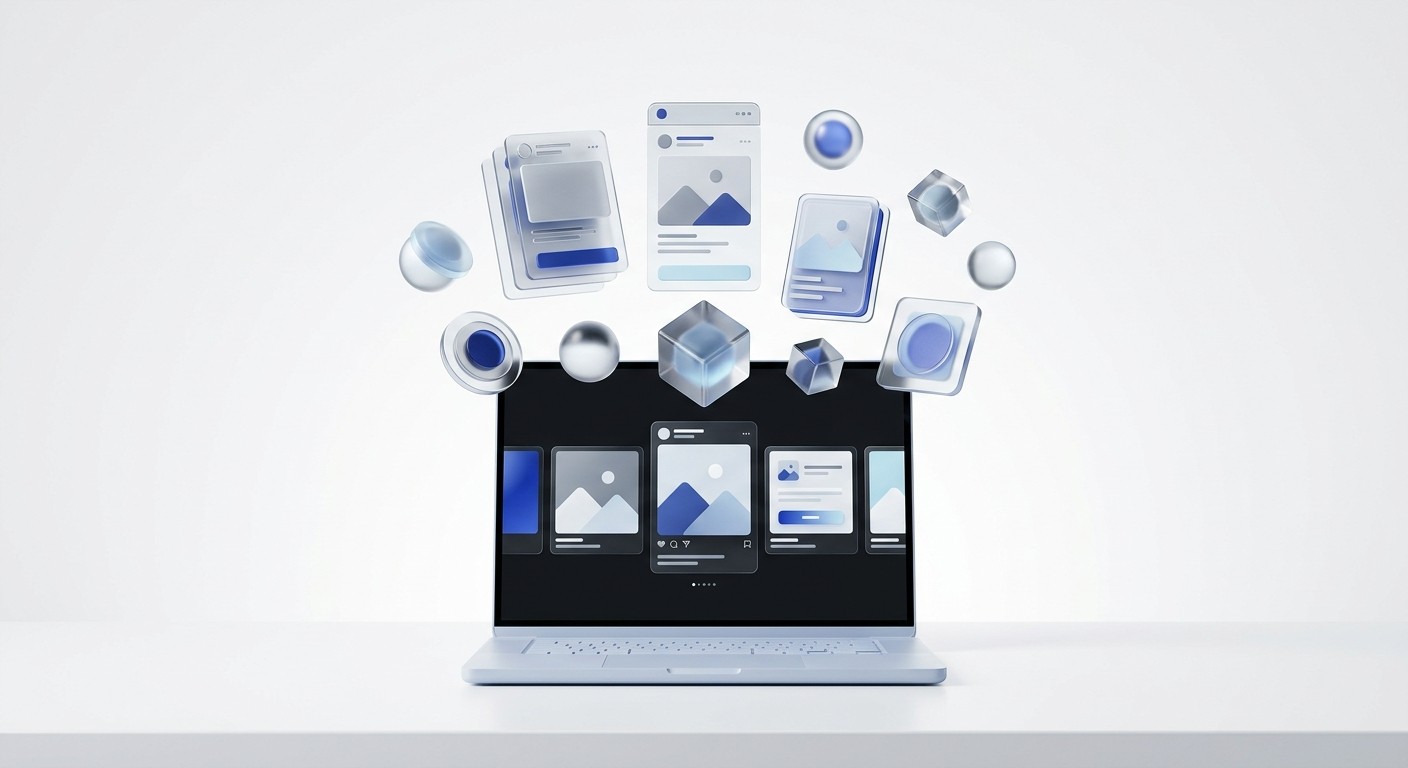
A modern b2b saas visual identity is the strategic use of typography, color, and layout to communicate technical competence. Building a premium brand aesthetic reduces friction in the enterprise buying journey and accelerates audience growth. You can achieve this by studying the strict, minimalist design systems of top-tier software companies.
What defines a modern B2B SaaS visual identity?
A b2b saas visual identity is the cohesive system of typography, color tokens, layout principles, and component design that translates a software product's functional value into a recognizable brand. The answer is not just a logo; it is the visual infrastructure that signals trust, technical competence, and premium positioning to enterprise buyers.
We recommend treating visual design as software engineering. Founders who prioritize design systems scale faster because they avoid treating every new social media post as a bespoke project. They build reusable components instead. This reduces the friction of publishing content, allowing marketing teams to maintain a high velocity of output without sacrificing quality.
The financial impact of this visual infrastructure is highly measurable. Less than 10% of B2B companies report having fully consistent branding across all touchpoints, yet those that do experience significant commercial advantages (Marketing LTB, 2025). Brands with a consistent visual identity across platforms enjoy a 33% higher brand recall rate. Furthermore, 68% of companies state that maintaining brand consistency has contributed directly to a 10% to 20% growth in their overall revenue. This is particularly relevant in the enterprise software space, where buyers are inundated with identical feature sets and overlapping value propositions. A recognizable brand acts as a cognitive shortcut for decision-makers. When you distribute social media content, slide decks, and product documentation that share a strict, unified aesthetic, you reduce friction in the buying journey. Buyers associate the premium quality of the visual presentation with the underlying technical reliability of the software.
Building this consistency requires discipline. You must commit to a very narrow set of design constraints. By eliminating arbitrary choices from your daily workflow, you ensure that every asset you publish reinforces your core brand values. We find that the most effective marketing teams operate with fewer than five core visual rules.
How does Vercel master stark technical minimalism?
Vercel masters stark technical minimalism by using pure black-and-white layouts, geometric primitives, and a rigid grid system to communicate extreme engineering precision. The answer is a visual identity that strips away all decorative elements, focusing entirely on high-contrast typography and developer-centric data visualization.
Their audience consists of highly technical frontend engineers who are allergic to traditional marketing. By mirroring the aesthetics of a code editor, Vercel immediately signals that their product is built for serious developers. We use similar stark principles when constructing high-converting carousel layouts. A pure white or pure black background removes visual clutter, forcing the reader to engage directly with the text.
This aggressive subtraction of color forces the content to carry the entire visual weight of the brand. By restricting their palette to monochrome with extremely rare accent colors, Vercel creates an aesthetic that feels entirely like an integrated development environment. It is a highly effective strategy for capturing developer attention. Recent data underscores why this matters: 81% of B2B ads fail to capture adequate attention or drive ad recall among target buyers (The Egg Company, 2025). Vercel cuts through this noise by refusing to look like a traditional advertisement. When they publish technical updates or framework benchmarks on professional networks, the starkness of their graphics immediately halts the scroll. The pure black background paired with sharp sans-serif typography has become instantly recognizable. This proves that intentional restraint is often more memorable than complex illustrations or busy graphic design.
You can replicate this by limiting your color palette. Eliminate gray mid-tones and focus purely on maximum contrast. We advise teams to set their background to dark mode and text to pure white for technical announcements. This extreme polarity draws the eye directly to the data being presented. By removing the safety net of soft grays, you force your typography to do the heavy lifting.
Why is Linear considered the gold standard for startup social media aesthetic?
Linear sets the gold standard for the startup social media aesthetic by treating their marketing assets with the exact same craft as their product interface. The answer is a distinctive dark-mode presentation featuring subtle purple and blue mesh gradients, monospaced functional text, and obsessive attention to spatial alignment.
Their design team clearly operates on strict component rules. Every asset they publish shares identical padding, corner radii, and drop shadow values. We find that template-based systems dramatically reduce revision cycles because changes propagate through components automatically. The consistency is what makes the output look premium.
This uncompromising dedication to visual craft generates extraordinary commercial results without relying on massive advertising budgets. Linear achieved a 400 million dollar valuation and built a highly engaged user base while spending only 35,000 dollars on lifetime marketing (Eleken, 2026). They accomplished this impressive growth by making their product updates visually viral. Every changelog release is accompanied by a meticulously designed social media asset that looks like premium hardware photography rather than standard software screenshots. The dark backgrounds absorb attention, while the glowing interface elements pull the viewer directly to the new feature. This approach proves that a premium visual identity is a highly efficient growth mechanism. When your social media graphics look significantly better than the standard corporate collateral crowding the timeline, founders naturally share them as design inspiration, creating a compounding loop of organic reach.
Reaching this level of quality requires you to stop using generic stock templates. You must build assets that look like your actual software. We suggest creating high-fidelity mockups of your core UI components within Figma. Use these exact vectors as the focal point for your marketing graphics to ensure a direct connection between your promotional content and the actual user experience.
How does Stripe use b2b visual branding to build trust?
Stripe uses b2b visual branding to build trust by combining complex, math-driven background gradients with flawless typographic hierarchy and structured documentation layouts. The answer is a design system that visualizes complicated financial infrastructure as something both highly advanced and completely accessible.
Typography is the foundation of their communication. They utilize a custom typeface that balances mechanical precision with editorial readability. When you ask enterprise companies to process millions of dollars through your API, a playful font introduces subconscious doubt. A highly structured typographical hierarchy signals operational maturity.
The impact of Stripe’s design choices extends far beyond mere aesthetics; it fundamentally alters how developers perceive the reliability of their payment processing infrastructure. Trust is the most critical metric for any financial technology product, and Stripe engineers that trust through visual perfection. This aligns with broader industry data regarding buyer behavior. 90% of consumers and enterprise buyers expect a strictly consistent brand experience across all marketing channels (We Are Tenet, 2026). Stripe delivers this consistency ruthlessly. Whether you are reading their API documentation, viewing a LinkedIn carousel about a new product launch, or logging into the dashboard, the precise typography and signature slanted geometric patterns remain identical. This extreme predictability signals to prospective clients that the underlying codebase is just as organized and stable as the surface-level design, reducing the perceived risk of adopting their software.
Small details matter when selling enterprise software. Precise alignment and mathematical spacing communicate that your engineering is equally precise. We recommend defining your layout grids using multiples of eight. Applying an 8-pixel spacing system ensures that all elements align perfectly, creating a subconscious feeling of stability and order for the end user.
What can founders learn from Raycast's tech startup design trends?
Founders can learn that adopting tech startup design trends means mirroring the native environments where your users spend their time. The answer is Raycast’s decision to adopt a command-line aesthetic, using glowing red and orange accents against a deep macOS-native interface to immediately signal keyboard-centric productivity.
We advise startups to adopt the visual language of their users' primary workspace. Raycast targets developers who spend hours in their terminal. By reflecting that environment, complete with keyboard shortcut tooltips and high contrast, they create an immediate sense of familiarity.
Raycast demonstrates that leaning heavily into a specific platform's design language can rapidly accelerate product adoption among power users. Instead of inventing a completely novel visual language, they elevated the familiar spotlight search interface into a premium brand asset. This strategy is particularly effective for social media distribution. When demonstrating keyboard shortcuts or new extensions, carousel posts are the optimal delivery mechanism for this type of sequential information. Recent platform data shows that multi-image carousels generate the highest average engagement rate on professional networks at 6.60%, significantly outperforming static images and text posts (SocialPilot, 2025). By formatting their feature updates as sleek, multi-slide tutorials that highlight exactly what the user will see on their screen, Raycast maximizes this format's potential. The visual identity serves purely to frame the speed and utility of the tool itself, keeping focus on action.
Action-oriented graphics always outperform abstract concepts. Show the user exactly what they will type and what the software will output. We suggest using screenshots of the actual product interface rather than vector illustrations. When you crop tightly around a specific UI component, you remove unnecessary context and guide the viewer's attention to the core feature.
How does Supabase apply minimalist saas branding for developers?
Supabase applies minimalist saas branding by combining dark mode terminal interfaces with a signature neon green accent color that instantly evokes traditional coding environments. The answer is an open-source aesthetic that strips away corporate polish in favor of raw, authentic developer utility.
Open-source software companies face a unique branding challenge. They must appear sufficiently polished to secure enterprise contracts, yet sufficiently raw to maintain credibility with independent developers. Supabase navigates this tension perfectly by keeping their marketing assets hyper-technical.
This deliberate rejection of traditional corporate design helps Supabase position itself as the authentic alternative to incumbent cloud providers. By using a bright neon green against near-black backgrounds, they create a visual hierarchy that naturally directs attention to critical code snippets and terminal commands. It is a highly strategic approach to visual identity. Maintaining this specific color palette across their code repositories, technical blogs, and social feeds builds rapid cognitive association. Less than 10% of B2B companies claim to have fully consistent branding across all channels, leaving a massive opportunity for startups that can enforce strict visual rules (Marketing LTB, 2025). Supabase capitalizes on this void by ensuring their signature green is never diluted. Whether an engineer encounters a diagram on a timeline or a tutorial document on their website, the brand is immediately identifiable without needing to read the logo.
You do not need a massive color palette to stand out. One highly specific, consistently applied accent color is far more memorable. We often build templates for clients that rely on exactly two colors: an almost-black background and one aggressive accent hex code. This forces the content to remain the center of attention.
Where do founders find reliable saas branding inspiration?
Founders find reliable saas branding inspiration by studying the changelogs, API documentation, and social media feeds of developer-first companies rather than traditional marketing agency portfolios. The answer is to look at how high-growth startups present dense, technical information clearly through structured layouts and typography.
Standard design portfolios prioritize artistic expression. Software marketing requires clear communication of utility. The best reference material comes directly from the companies shipping successful software to the exact audience you are trying to reach.
Analyzing top-tier software companies reveals that the most effective marketing assets are educational rather than promotional. Founders should observe how companies like Linear and Vercel break down complex features into digestible, multi-slide social media posts. The mechanics of these formats are just as important as the aesthetics. Users spend an average of 15 to 20 seconds consuming carousel posts, compared to just 8 to 10 seconds for standard text or image updates (Meet Lea, 2026). This extended dwell time provides the necessary space to explain technical value propositions. Translating this inspiration into daily output requires systematic tools. Using a structured framework like the social media carousel templates from usevisuals allows teams to bypass the blank canvas phase. You lock in your specific brand colors and typography variables once, enabling anyone on your team to publish high-dwell-time educational content that maintains a premium, consistent appearance.
Stop collecting abstract mood boards from consumer brands. Start screenshotting exact carousel layouts that successfully explain complex technical features. We recommend building a swipe file specifically for B2B layouts. Whenever you see a post that makes a complicated API integration look simple, save it. Break down the structural grid they used to organize the text.
How do you build software company brand guidelines without an agency?
You build software company brand guidelines by starting with a minimal, strictly enforced set of rules covering one typography family, three core color tokens, and a universal grid system. The answer is to document constraints rather than infinite possibilities, ensuring your non-designers cannot break the b2b saas visual identity.
Auto-layout in Figma is a feature that lets components resize dynamically based on their content. We strongly suggest using it to build your foundational social media templates. When the design system handles the spacing automatically, marketing managers can generate assets without needing constant design reviews.
Core Components of a Minimalist Guideline
A functional guideline does not require complex documentation. Focus on establishing the foundational tokens that dictate your daily output. We find that the most effective marketing teams operate with fewer than five core rules.
Typography scale: One sans-serif for headings and body text, plus one monospaced font for code snippets.
Color palette: A primary brand color, a secondary accent, and a strict 10-step grayscale for UI elements.
Spatial system: An 8-pixel grid system applied universally to padding, margins, and component sizing.
Design System Consistency Metrics
Brand Element | Traditional Approach | Modern B2B SaaS Approach |
|---|---|---|
Color Palette | Extensive gradients and multiple primary colors | Monochrome backgrounds with a single vibrant accent |
Typography | Decorative display fonts mixed with standard fonts | High-legibility sans-serif paired with functional monospace |
Marketing Graphics | Abstract illustrations and stock photography | Real product interfaces with exact technical data |
The most successful internal design systems prioritize strict limitations over creative freedom. A functional guideline only needs a primary action color, a complete grayscale for backgrounds and text, a monospaced font for technical data, and a highly legible sans-serif for marketing copy. Documenting these few decisions is far more effective than commissioning a hundred-page brand book that no one reads. The operational efficiency of this approach is backed by industry practice. Currently, 82% of organizations use dedicated templates to ensure brand consistency across their marketing output (Capital One Shopping, 2025). By baking your guidelines directly into reusable component libraries within Figma, you eliminate the possibility of off-brand variations. When a marketer needs to announce a new feature, they simply drop their text into a pre-configured layout block. This ensures the visual identity remains intact, projecting the authority and polish of an enterprise market leader.
References
Branding Statistics 2026: 98+ Stats & Insights. Marketing LTB, 2025.
B2B Marketing and Brand Recognition: Why It Matters More Than Ever. The Egg Company, 2025.
Linear App Case Study: How to Build a $400M Issue Tracker. Eleken, 2026.
50+ Branding Statistics for 2026 That Explain Brand Loyalty. We Are Tenet, 2026.
LinkedIn Carousel Posts: Specs, Steps And Examples. SocialPilot, 2025.
LinkedIn Carousel Engagement 2026: Performance Benchmarks. Meet Lea, 2026.
Branding Statistics (2025): Awareness, Recognition & Trends. Capital One Shopping, 2025.