Should a small SaaS website create FAQ pages for SEO
Decide whether recurring questions belong on product pages, support docs, educational articles, or one cohesive FAQ destination.

For years, FAQ advice followed a familiar shortcut. Collect questions, add FAQ structured data, and hope the search result expands. That incentive no longer supports a general content strategy for most company websites.
Google announced that FAQ rich results would generally be limited to well-known government and health sites. A small SaaS company should therefore decide whether an FAQ page deserves to exist as a reader destination, not as a markup tactic.
The practical answer to FAQ pages for SEO is conditional. Build one when a coherent group of recurring questions shares the same reader, moment, and decision. Otherwise, place each answer where it naturally helps, such as a product page, support article, onboarding flow, or deeper educational post.
Remove the rich-result incentive first
Google's update on FAQ and HowTo rich results says FAQ rich results are now regularly shown only for authoritative government and health websites. For other sites, the markup may have no visible effect in search.
That change does not make questions useless. It removes a distorted reason for collecting them on one page.
Ask what the page would do if no special result appeared. Would customers use it before buying. Would support teams link to it. Would the answers reduce uncertainty around one decision. Would the company maintain it when the product changes.
If the page has no job without the markup, do not build it.
Route questions to four destinations
Every recurring question belongs where the reader needs the answer.
Product or pricing page
Place a question here when it directly affects the decision on that page. Billing cadence, plan limits, implementation requirements, and cancellation conditions often belong close to the offer. Do not make a buyer leave the page to find essential terms.
Support documentation
Place a question here when the reader is trying to complete a task inside the product. The answer may need steps, screenshots, version notes, permissions, and troubleshooting detail. A marketing FAQ is usually too shallow for this job.
Educational article
Create an article when the question requires context, tradeoffs, examples, or a framework. “What is content governance” may need a complete explanation. Reducing it to two sentences can leave the reader with no usable understanding.
Cohesive FAQ page
Use a dedicated FAQ when several short answers serve the same audience at the same stage. A security review FAQ, partner program FAQ, or event attendee FAQ can work because the questions share a bounded context.
The page should not be the place where every unassigned question goes.
Apply the question-cohesion test
Take the proposed question list and test five dimensions.
The same reader asks most of these questions
The questions arise in the same moment or decision
Each answer can be complete without a full separate article
The page has one clear owner and update trigger
The group has a natural title beyond
Frequently asked questions
If several dimensions fail, split the list and route the questions elsewhere.
Consider these items.
How long does setup take
Can I invite contractors
What is content operations
How do I reset my password
Do you offer annual billing
They may all be asked frequently, but they do not share one reader job. Setup and collaboration may belong on product pages. The definition may deserve an educational article. Password reset belongs in support. Billing belongs near pricing.
Frequency alone is not a content architecture.
Design one page around a bounded decision
Imagine a SaaS company needs an implementation FAQ for prospective customers. The reader is evaluating whether the product can fit an existing workflow before buying.
The page can include questions about setup responsibility, access requirements, data import, typical stages, support boundaries, and handoff. The questions share one moment and can be answered concisely.
Give the page an introduction that names its scope. Group questions under descriptive H2 sections such as Before setup, Access and data, and Launch and support. Use each question as an H3 only when that reflects the true heading hierarchy.
Link to deeper documentation where the answer requires details. The FAQ answer should provide enough context for the reader to decide whether the linked resource is relevant.
Add a clear path for an unanswered question. That might be a contact form, support search, or sales conversation depending on the page's audience.
Write answers that close the loop
A useful answer should resolve the question directly, state important boundaries, and point to the next resource only when needed.
Weak answer
“Setup times vary. Contact us to learn more.”
Stronger answer without invented precision
“Setup depends on the number of content sources, required approvals, and whether historical material must be imported. The implementation plan confirms owners and access before migration begins. Contact the team with your current source list for a scoped estimate.”
The stronger version explains the variables and next step without inventing a universal number.
Avoid filler openings such as “Great question.” Avoid repeating the question before answering. Avoid using the FAQ to hide essential conditions that should appear in product or pricing copy.
Use structured data only when it matches the page
If the site chooses to retain or add FAQPage markup, the visible content and structured data must agree. Google's general structured data guidelines say the markup should represent visible page content and should not be misleading.
Do not add question markup to content that is not a genuine FAQ page. Do not mark up answers hidden from users. Do not describe the implementation as a guaranteed rich-result tactic.
The engineering cost may not be justified for a small SaaS site if the markup has no current visible search feature for that site. Make the decision from maintenance value and broader data needs, not an outdated screenshot.
Let customer language shape the questions
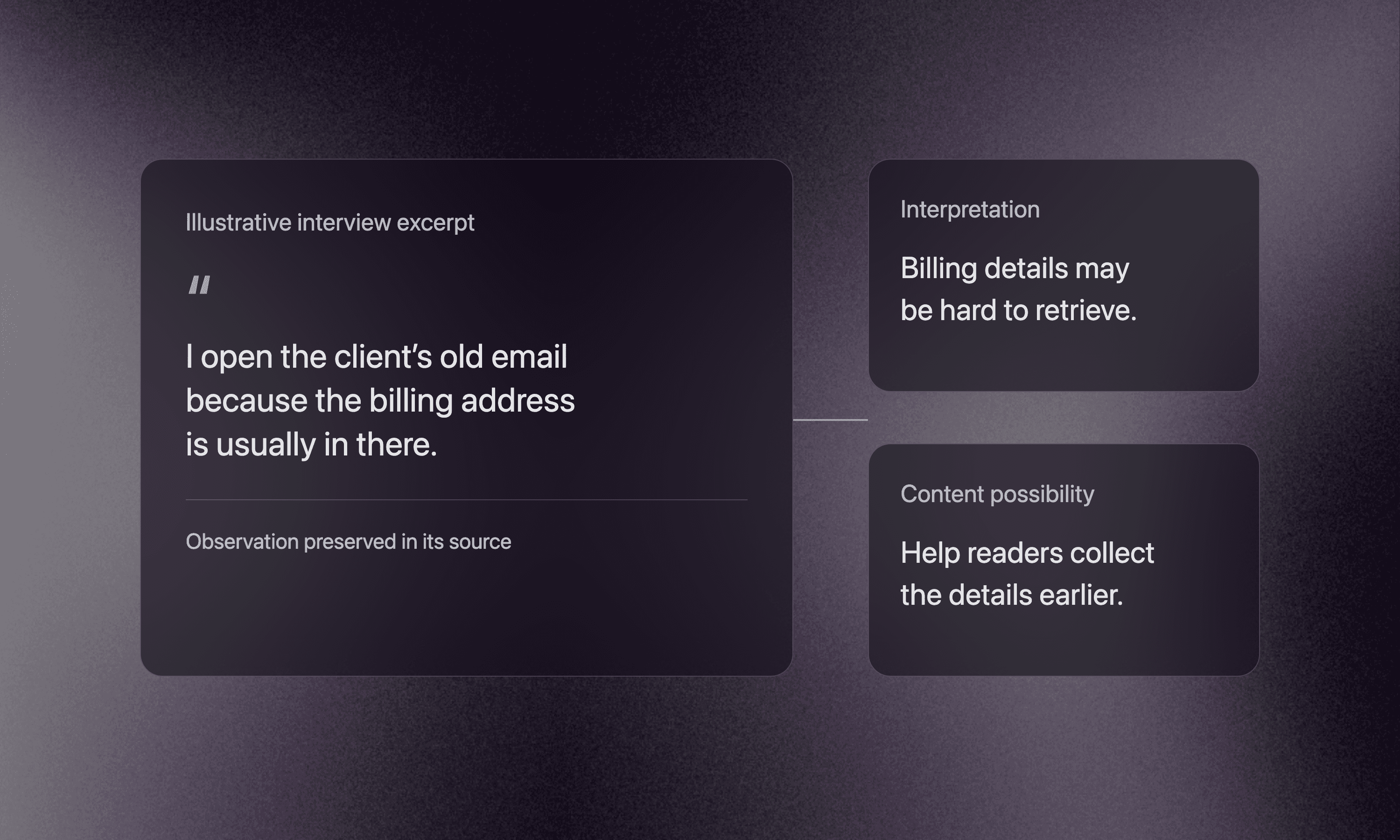
Question wording should come from real conversations, search queries, sales notes, support tickets, onboarding calls, and product feedback. Preserve the reader's language where it remains accurate and respectful.
Then edit for clarity. Several variants may express one underlying uncertainty. Combine them into a stable question rather than publishing near-duplicates.
Record the source and owner for each question. A sales objection and a support failure may look similar but need different answers. The source helps the editor understand the reader stage.
Do not claim a question is frequent without evidence. The page can answer important questions that occur occasionally. Importance and frequency are different reasons for inclusion.
Keep the page from becoming a content graveyard
FAQ pages tend to grow because adding a new accordion feels easier than deciding where an answer belongs.
Set an admission rule. A new question must pass the cohesion test, fit the page scope, and have an owner. If it needs more than a concise answer, create or update the deeper destination and link to it.
Review the page when the product, pricing, policies, or implementation process changes. Test every link and confirm that answers still match visible product behavior. Remove questions that no longer occur or move them when another page becomes the better home.
Accordion interfaces also need accessible implementation. The question should remain discoverable, the control should communicate its expanded state, and the answer should be usable with keyboard and assistive technology. A plain list of headings and paragraphs can be better than a broken interactive component.
Know when to delete or split the page
Retire or redesign the FAQ when one of these conditions appears.
Most answers duplicate stronger pages
The questions serve unrelated readers and stages
The owner cannot keep product details current
The page receives traffic but does not resolve the intended decision
Support and sales teams rarely use it
The interface hides content or creates accessibility problems
Preserve redirects when the URL has useful links and a true replacement exists. If the page splits into several destinations, choose the destination that best matches the old page's main job rather than redirecting mechanically.
Build destinations, not question collections
A dedicated FAQ page can be valuable. It can reduce uncertainty, give teams one link for a bounded set of answers, and reveal gaps in product communication. Those benefits come from cohesion and maintenance, not from the number of accordions or a markup promise.
Remove the rich-result incentive from the decision. Route questions to the page where they help most. Build an FAQ only when the remaining questions share a reader, moment, and job. Give the page a real owner and delete it when that cohesion disappears.
The result may be fewer FAQ pages and better answers. That is a stronger search and customer experience because every question has a destination designed to resolve it.