Group Search Console queries with regex before choosing what to update
Group related Search Console queries with practical regex filters, account for report limits, and turn patterns into clear editorial decisions.

The query table in Google Search Console can make a healthy content topic look fragmented. One person searches for “content workflow,” another types “weekly content process,” and a third asks how to organize blog production. Reading those rows one by one hides the shared job behind them.
Search Console regex filters let you group those variations into a working query family. The useful result is not a prettier report. It is a better editorial decision. A group can show whether a page already answers a coherent need, attracts mixed intent, or needs a clearer promise.
The method works best when you treat regex as a lens, not a source of perfect totals.
Start with the decision you need to make
Do not open the report and start inventing patterns. Write the decision first.
Useful decisions include these.
Should one article be refreshed or should the topic split into two pages?
Does the page attract people looking for a process, a template, or a tool?
Are comparison queries appearing around an informational article?
Is a cluster gaining impressions without earning clicks?
Each decision suggests a different query family. If the question is whether readers want a template, the pattern should collect words such as template, checklist, and example. If the question is whether the page attracts comparison intent, it might collect vs, alternative, and compare.
This order matters. A pattern created without a decision tends to produce a group that is technically valid and editorially useless.
Build four query families
A simple content review usually needs no more than four families.
Core job
This group captures the main problem the page intends to solve. For an article about a newsletter workflow, a first pattern might be (newsletter workflow|newsletter process|email workflow).
Google says Search Console uses RE2 syntax and treats regex matches as partial by default. That means a pattern can match anywhere in a query unless you add anchors for the start or end of the string. The default is also case-insensitive. Those details are easy to miss, so keep the first pattern plain and test the returned rows before adding complexity. The current advanced filtering guide documents the supported behavior and common operators.
Format demand
This family looks for the form people want. Common terms include template, checklist, examples, guide, calculator, and framework.
The group can change the article without changing its topic. If a useful page earns impressions for “content audit checklist” but contains only prose, the gap may be the missing operating aid. The correct response could be a downloadable checklist, an in-page table, or a clearer sequence.
Do not add every possible format word. Use terms you have actually seen in the table or heard from buyers. The pattern should reflect evidence, not an imagined search vocabulary.
Stage or sophistication
Words such as beginner, advanced, small team, founder, or B2B reveal who expects the page to fit them. A page can rank for the right topic while feeling wrong for the person who arrives.
This group is especially useful when a broad article has grown over time. If beginner and implementation-heavy queries both appear, the answer may be a clearer first section, a separate advanced resource, or a more precise title. It is not automatically another article.
Alternative intent
The final family catches a neighboring job that could pull the page off course. Comparison words, software terms, pricing language, or hiring questions often signal a different decision.
Suppose an educational page about content systems starts appearing for “content calendar software.” Adding a software roundup to the article might weaken it. A short distinction near the opening could be enough. If the alternative group becomes substantial and coherent, it may deserve a separate page.
Read patterns as evidence cards
For each family, create a small record with four fields.
The exact regex used
The date range and page filter
What the rows appear to say
The editorial action, if any
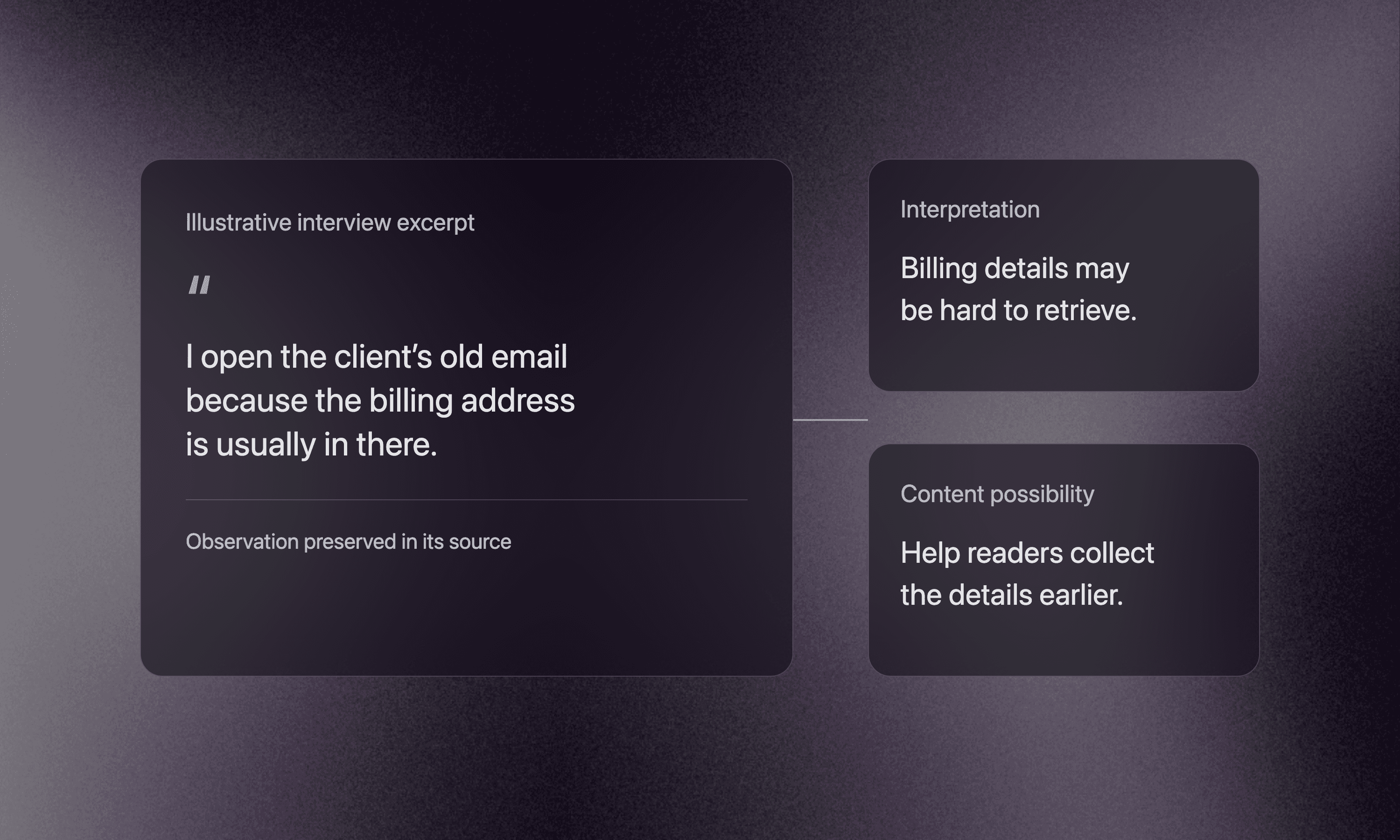
Keep observation and interpretation separate. “Queries containing checklist gained impressions” is an observation. “Readers need a downloadable asset” is an interpretation. The second statement may be reasonable, but it should remain a hypothesis until the page and search results are reviewed.
That separation prevents a common mistake. Teams often convert a report pattern directly into a publishing task. A query family is a reason to inspect the page, not proof that a new asset will perform.
Account for what the report cannot show
Filtered Search Console data is not a complete census of demand. Google notes that anonymized queries are omitted to protect privacy. It also explains that tables can be truncated and may not show every query. Applying query filters can change totals because anonymized queries are dropped from the filtered view. The dimensions and groupings documentation describes these limitations.
Three practical rules follow.
Compare trends inside the same filter setup instead of treating the number as an absolute market size.
Save the pattern with the decision so another reviewer can reproduce the view.
Avoid precise claims such as “this family represents 38 percent of demand” unless the data and method truly support them.
Regex also creates its own risks. Partial matches can collect unintended words. A broad fragment such as ai can appear inside unrelated terms. Review the returned queries, tighten the pattern, and record exclusions when needed.
Turn the groups into an editorial decision ledger
Imagine a page about creating a weekly content workflow. The review produces this ledger.
Query family | Observation | Interpretation | Decision |
|---|---|---|---|
Core job | Workflow and process variations appear consistently | The page matches a coherent operational need | Keep the central promise |
Format demand | Checklist and template terms appear | Readers may want a reusable aid | Add a compact weekly planning table |
Stage | Founder and small-team terms appear | Examples should fit limited resources | Replace enterprise examples |
Alternative | Calendar software terms appear occasionally | Some readers confuse a calendar with a workflow | Add a short distinction, not a software roundup |
The ledger is more useful than a list of keywords because it preserves judgment. It also makes future reviews easier. A later editor can see why the article changed and whether the expected query family became clearer.
Use one report to improve one page
The fastest way to learn Search Console regex filters is to avoid a site-wide project. Pick one page with enough impressions to produce varied queries. Define one decision, create up to four families, inspect the returned rows, and make at most one meaningful change.
Then add the page to a review queue rather than declaring the optimization finished. Search data moves slowly, and other factors can change at the same time. The point is not to prove that one edit caused a result. It is to make editorial work more deliberate.
Regex earns its place when it turns a long query table into a small set of understandable reader jobs. If the pattern does not help you decide what the page should do, simplify it or remove it.